Tag: Talks

  • Talk at ASPERA 2016, ‘The filmmaker is present …’

    Talk at ASPERA 2016, ‘The filmmaker is present …’

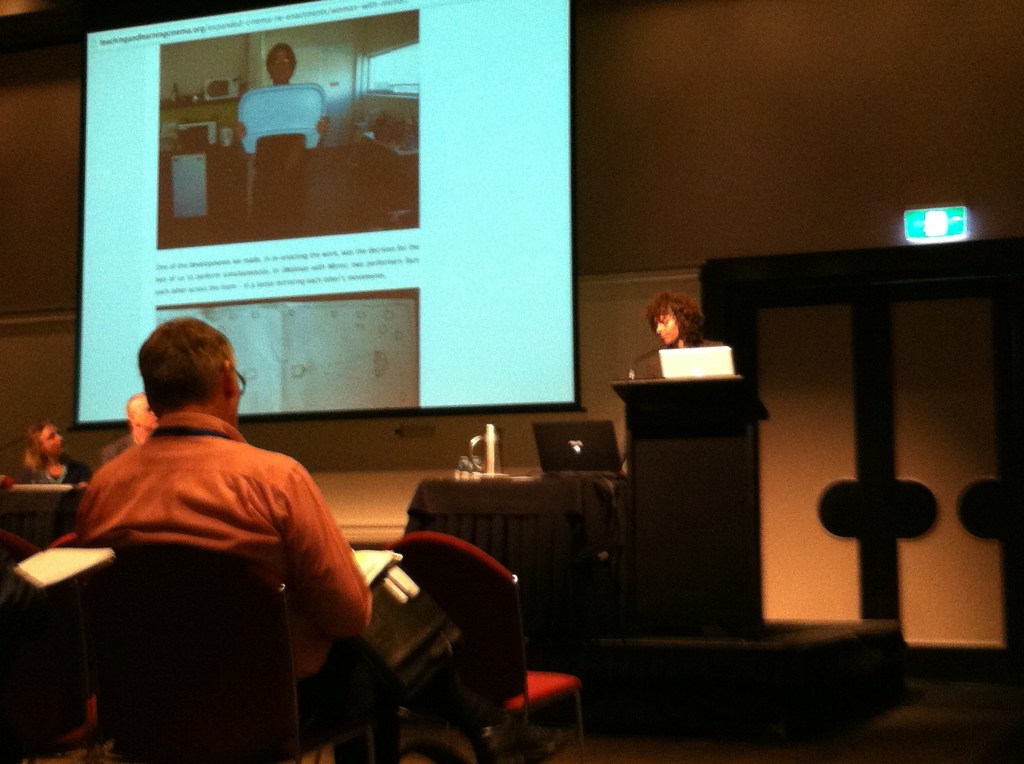
    ‘The filmmaker is present – experiment, process, image – a practitioner’s talk about process as the focus of moving image works’, Louise Curham at the Australian Screen Production Education & Research Association 2016 conference, University of Canberra, July 5-7.

    What happens when we scrap pre-production, production, post-production instead focusing on process alone? I am going to discuss process-based experimental techniques as productive strategies to make moving image works.

    Why have I proposed this discussion for the screen production education and research community? The first reason is that you teach. I have used this process-only approach productively in my sporadic teaching activity.The second reason is research and re-enactment, one of the three strategies, is intrinsic to my PhD.

    The film industry talk about pre, prod and post as a process. Workflow strikes me as a better word for pre, prod and post, focused as it is on pre-conception, execution and delivery of a product. This thinking relies upon a pretty clear idea of what you want to achieve before you start and built into this pre-visualisation is a preconception of what success will look like. Of course, happy accidents occur and conversely, and things don’t turn out as planned but in essence, the work is laid out before you begin.

    My provocation is that there is much to be gained in a learning situation if the emphasis is on the learning process as an end in itself. Now I am not a professional educator. I’m making this statement from observations of myself at work and watching others in learning environments I’ve set up – my fairly frequent guest lectures and workshops.

    Intentional Malfunction 01

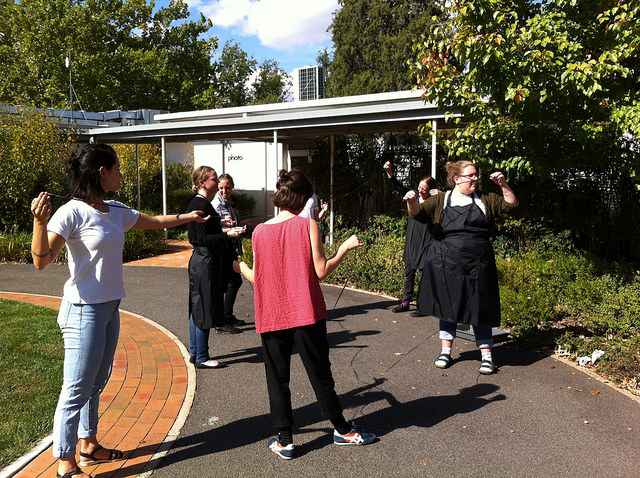
    Intentional Malfunction workshop participants dry their hand processed super 8 outside PhotoAccess, Manuka. Another image of this workshop heads up this post. (more…)

  • Talk for the 2015 Australian Society of Archivists conference, ‘Tending the Archive’ by Ihlein & Curham

    Talk for the 2015 Australian Society of Archivists conference, ‘Tending the Archive’ by Ihlein & Curham

    Talk presented by Louise Curham at the Australian Society of Archivists 40th annual conference, ‘Archives on the Edge’, Hobart, 20 August 2015 in Session 17, The Creative Perspective. The talk was based on the article ‘Reaching Through to the Object: Reenacting Malcolm Le Grice’s Horror Film 1’, (Ihlein & Curham, 2015), based on the Ihlein Curham collaborative project Teaching and Learning Cinema.

     Welcome and thank you. The abstract promised two of us, myself and Dr Lucas Ihlein, artist and media arts lecturer, at the University of Wollongong. Lucas unfortunately had to be in Canada on family duties and to present research at another conference.

    Here’s a statement of purpose – our aim with this talk is to put forward ideas that we think are relevant to the archival community that have emerged from our work with live art from the past. Our work involves a remaking process or ‘re-enactment’. In short this re-making process involves using existing archives and generating new ones. We try to get as close as we can to the original work. And yet as we ‘reach through’ to it, we find we must make changes to it because the conditions we find ourselves in are different from those when the work was originally created. This process sheds light on the original work, and the changes we make are subtle forms of new knowledge about it. It’s the generation of new knowledge in this process that we have come to think of as a kind of tending. Buried in ‘tending’ is an idea about ways to appropriately contribute to the record of the past and it’s this idea that is probably what is most relevant to you as archivists. And I’ve been hearing this as a bit of a theme in the conference. (more…)

  • ‘Tending the archive’ talk for Australasian Association of Digital Humanities conference 2016

    ‘Tending the archive’ talk for Australasian Association of Digital Humanities conference 2016

    [The talk was intended to be accompanied by video documentation of the inaugural TLC performance of re-enactment (Wo)Man With Mirror in 2009 here https://vimeo.com/8855880].

    This short paper is an initial sketch exploring a possible shift in our mental map of how we care for things that are prone to disappearance, including the digital.

    My background attunes me to things prone to disappearance. It has two parts – one in the arts, specifically obsolete moving image, think hand made film made using obsolete techniques and equipment and as we shall, re-enactment of live art from the 1970s. The other part is in archives – in the past, I worked in film preservation, more recently on digital records of government, engineering them and appraising them and.

    I am currently part way through a PhD. Using a case study of resolutely analogue performance-dependent heritage, one way to caste my research is that it explores how we might re-think the preservation/access dilemma. By dilemma I mean that if we use things, we physically degrade them, and if we just preserve them without ever permitting a use for them, how do we justify keeping them? The field of conservation is predicated on this idea of ‘indefinite’ access. So in part, I am interested in looking again at this dilemma, inviting a re-reframing of archiving as a process of ‘tending’. In short, the tending idea puts use front and centre – through using things, we can maintain them and through embodied use, we can reinvigorate them.  This somewhat cryptic notion of ‘embodied use’ will become clear in the course of this paper.

    While my case (live art) is resolutely analogue, it can be caste as performance-dependent heritage along with heritage like motion picture film and digital records which rely on layers of technological performance to experience them. So this means my tending idea may resonate with dealing with digital stuff in general.

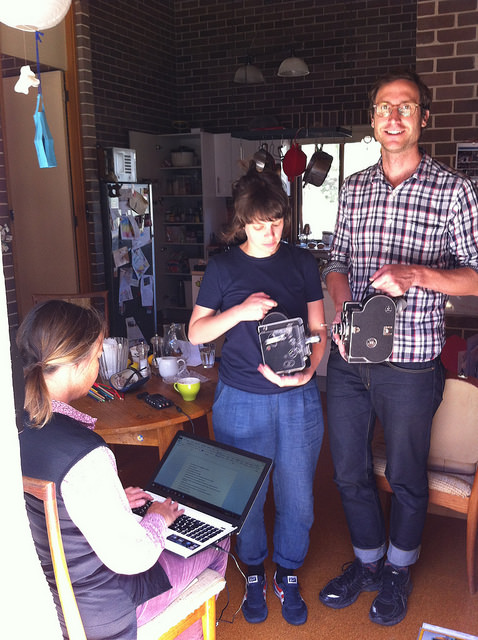
    The case study I will talk you through is drawn from my work in Teaching and Learning Cinema, an artist/archivist collaboration between me and artist Lucas Ihlein, drawing on my background in archives and experimental film and Lucas’ background in contemporary art. (more…)