Tag: re-enactment

  • Research

    Research

    Dr Louise Curham is an archivist, media artist and researcher based in Canberra. She is an online lecturer in Curtin University’s iSchool. Louise uses art and archives to explore themes that flow from old media, ranging from digitisation to the impact of algorithm-based technology on citizens.

    I finalised my PhD in the Centre for Creative & Cultural Research at the University of Canberra, Faculty of Arts & Design in 2021. You can read a blog post on my pre-submission seminar here. You can find my MFA thesis and other things on Academia. I write an occasional blog on things archives here Rambunctious Archives.

    Talks and presentations

    Curham L, Hanisch J. (2014). Towards improved metrics for information management. InForum, Records and Information Management Professionals Australasia conference, Adelaide.

    Ihlein L & Curham L. (2015). Tending the Archive. Australian Society of Archivists conference, Hobart ASA talk 2015 ‘Tending the Archive’.

    Curham, L. (2015). Tending the Archive. Talk to National Archives of Australia, Government Information Assurance and Policy branch professional update seminar.

    Ihlein L & Curham L. (2015). Panel convenors ‘Re-enactment / Repetition / Reiteration / Re-performance as embodied research’, Art Association of Australia & NZ (AAANZ) Conference, QAGOMA, Brisbane.

    Curham L. (2016). Tending the Archive. Australasian Association for the Digital Humanities conference, Hobart Digital Humanities talk 2016 ‘Tending the Archive’.

    Curham L. (2016). ‘Re-enactment practitioners’ chat’, convenor and presenter. Westspace, Melbourne.

    Curham L. (2016). The Filmmaker is Present. Australian Screen Production Education and Research Association conference ASPERA 2016.

    Curham L. (2016). Observing the Re-enactment. Scenes of the Real symposium, Department of Performance Studies, University of Sydney.

    Curham L. (2016). Expressive Instructions for Re-enactment. AAANZ conference ‘The Work of Art’, Canberra.

    Curham L and Jolly M. (2016). Convenors ‘In the Footsteps of Others’ panels for AAANZ conference ‘The Work of Art’, Canberra.

    Curham L. (2017). Tending the archive: ritual as preservation; enfolding preservation into use; and preservation as a community enabler through the case study of (Wo)Man With Mirror, a re-enactment of a 1970s artwork. ‘Shock of the New’, Australasian Institute for the Conservation of Cultural Materials joint SIG symposium, Melbourne.

    Curham, L. (2017). When the Record Performs. Australian Society of Archivists’ annual conference, Melbourne.

    Curham L. (2019). Creative Knowledge Management, PriceWaterhouseCoopers Festival of Creativity, Canberra.

    Curham L. (2019). Having Opinions in Digital Preservation, Australasia Preserves talks series, online.

    Curham L. (2019). The Wisdom Travels With the Object. ‘Archives in the Digital Age’ symposium for the launch of the Kaldor Digital Archives, Art Gallery of NSW.

    Publications

    Ihlein, L & Curham, L. (2015). ‘Reaching Through To the Object: Re-Enacting Malcolm Le Grice’s Horror Film 1’. Performance Matters 1 (1-2): 24–40.

    Curham L. (2016). ‘Caring for Live Art That Eludes Digital Preservation’. In Proceedings of the 13th International Conference on Digital Preservation, 266–67. Bern, Switzerland: Swiss National Library.

    Curham, L. (2017). ‘Performing Digital Multiple Perspectives on a Living Archive’. Archives and Manuscripts, 45(2), 167–169.

    Non-traditional research outputs

    Curham, L. (2015). dLux Media Arts Significance Assessment Report. Sydney: dLux Media Arts.

    Curham L. (2015). A film of one’s own [archive fever] solo exhibition. Canberra: PhotoAccess.

    Bullock O, Curham L, Florance C. (2016). Tracer. Performance for haiku, prepared screens and super 8 film. Canberra: You Are Here Festival.

    Cairncross B & Curham L. (2017). ‘The Parliament of Owls’, Underbelly Arts Festival, Sydney.

    Curham, L & Di Centa, D. (2018). In a Bone Way performance, Dance on the Edge season, Belconnen Arts Centre, Canberra.

    Curham L & Loo L. (2019). The Stand-in Lab exhibition. Canberra: PhotoAccess.

    Curham L & Griswold E. (2019) Dots and Loops Festival of New Music, Brisbane.

    Curham L & Cairncross B. (2019). In ‘Extra! Extra!’ organised by Lucas Ihlein, in the 50 Years of Kaldor Public Art Projects exhibition, Art Gallery of NSW.

  • Talk at ASPERA 2016, ‘The filmmaker is present …’

    Talk at ASPERA 2016, ‘The filmmaker is present …’

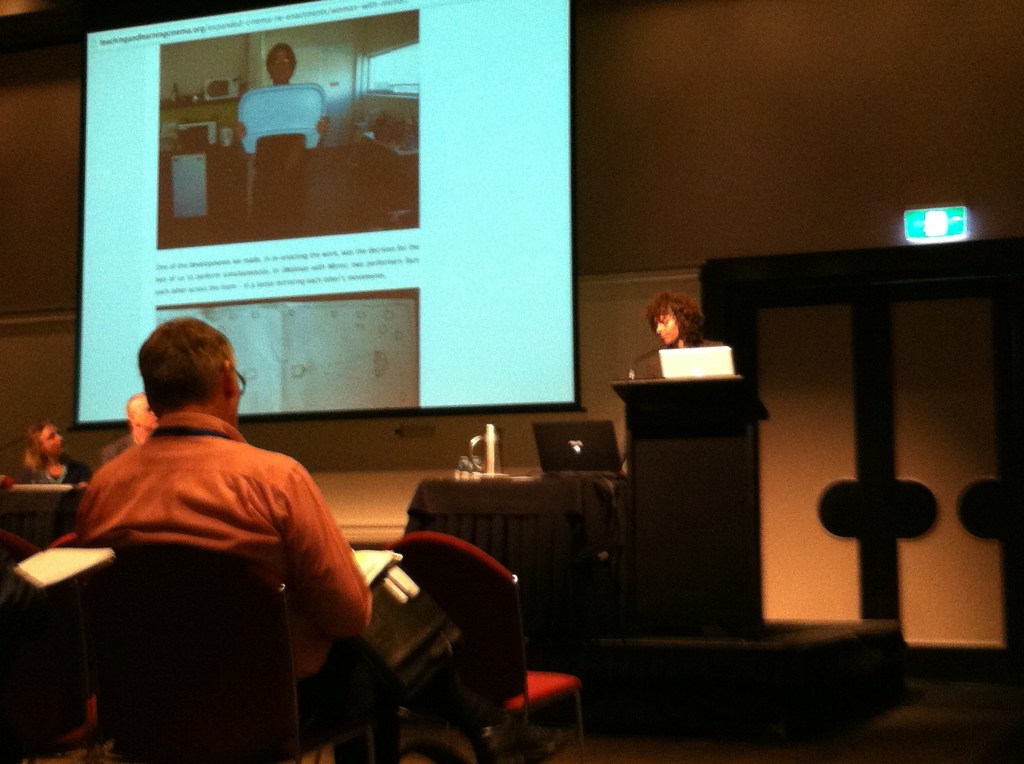
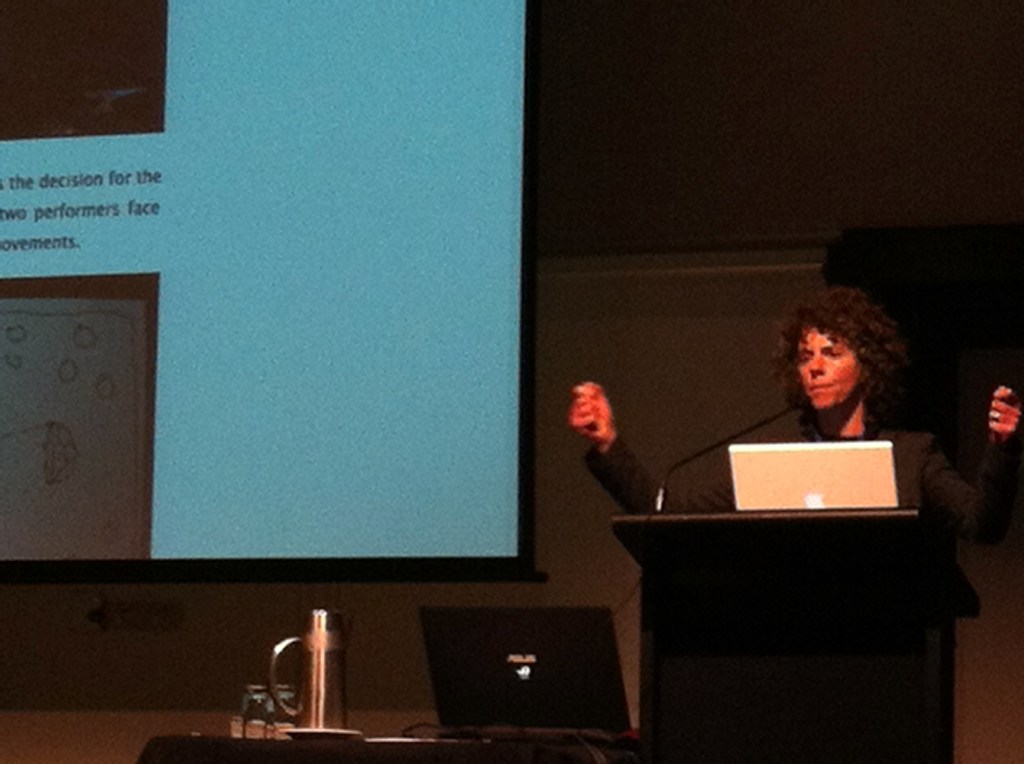
    ‘The filmmaker is present – experiment, process, image – a practitioner’s talk about process as the focus of moving image works’, Louise Curham at the Australian Screen Production Education & Research Association 2016 conference, University of Canberra, July 5-7.

    What happens when we scrap pre-production, production, post-production instead focusing on process alone? I am going to discuss process-based experimental techniques as productive strategies to make moving image works.

    Why have I proposed this discussion for the screen production education and research community? The first reason is that you teach. I have used this process-only approach productively in my sporadic teaching activity.The second reason is research and re-enactment, one of the three strategies, is intrinsic to my PhD.

    The film industry talk about pre, prod and post as a process. Workflow strikes me as a better word for pre, prod and post, focused as it is on pre-conception, execution and delivery of a product. This thinking relies upon a pretty clear idea of what you want to achieve before you start and built into this pre-visualisation is a preconception of what success will look like. Of course, happy accidents occur and conversely, and things don’t turn out as planned but in essence, the work is laid out before you begin.

    My provocation is that there is much to be gained in a learning situation if the emphasis is on the learning process as an end in itself. Now I am not a professional educator. I’m making this statement from observations of myself at work and watching others in learning environments I’ve set up – my fairly frequent guest lectures and workshops.

    Intentional Malfunction 01

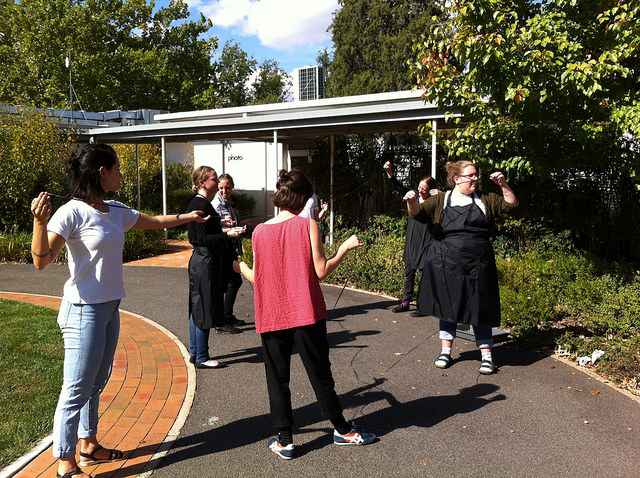
    Intentional Malfunction workshop participants dry their hand processed super 8 outside PhotoAccess, Manuka. Another image of this workshop heads up this post. (more…)

  • Talk for the 2015 Australian Society of Archivists conference, ‘Tending the Archive’ by Ihlein & Curham

    Talk for the 2015 Australian Society of Archivists conference, ‘Tending the Archive’ by Ihlein & Curham

    Talk presented by Louise Curham at the Australian Society of Archivists 40th annual conference, ‘Archives on the Edge’, Hobart, 20 August 2015 in Session 17, The Creative Perspective. The talk was based on the article ‘Reaching Through to the Object: Reenacting Malcolm Le Grice’s Horror Film 1’, (Ihlein & Curham, 2015), based on the Ihlein Curham collaborative project Teaching and Learning Cinema.

     Welcome and thank you. The abstract promised two of us, myself and Dr Lucas Ihlein, artist and media arts lecturer, at the University of Wollongong. Lucas unfortunately had to be in Canada on family duties and to present research at another conference.

    Here’s a statement of purpose – our aim with this talk is to put forward ideas that we think are relevant to the archival community that have emerged from our work with live art from the past. Our work involves a remaking process or ‘re-enactment’. In short this re-making process involves using existing archives and generating new ones. We try to get as close as we can to the original work. And yet as we ‘reach through’ to it, we find we must make changes to it because the conditions we find ourselves in are different from those when the work was originally created. This process sheds light on the original work, and the changes we make are subtle forms of new knowledge about it. It’s the generation of new knowledge in this process that we have come to think of as a kind of tending. Buried in ‘tending’ is an idea about ways to appropriately contribute to the record of the past and it’s this idea that is probably what is most relevant to you as archivists. And I’ve been hearing this as a bit of a theme in the conference. (more…)