Author: lcurham

  • Vale Malcolm Le Grice

    We, Lucas and I, are so saddened by the passing of Malcolm Le Grice. Our relationship with Malcolm starts back in 2008 when he visited Sydney and told Lucas he felt it was time to ‘hang up his boots’ on performing Horror Film 1.

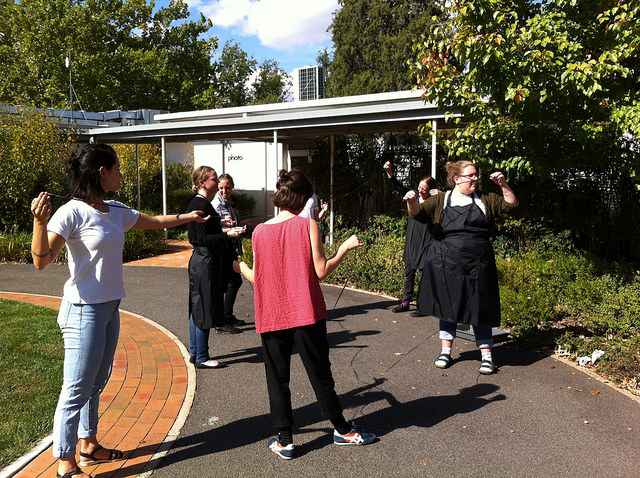
    Malcolm was aware of the work we had been doing with his London Film Makers’ Co-op colleague Guy Sherwin. The output of our work with Guy was (Wo)Man With Mirror a user’s manual, a fold out paper guide that steps the user through making a performance of Guy’s Man With Mirror. Malcolm’s Horror Film 1 has been seen by many people and as Malcolm has described it, it’s a crowd pleaser. He always programmed it last because he found that it was hard for works that followed it to make an impact.

    Over the past several years, Lucas, me, our data science friend in France, Raja Appuswamy, and Malcolm and his son Oliver have spent lots of time on video calls, talking about the evolving manual for Horror Film 1. We have been so lucky to roadtest this while Malcolm has been about. Performances using the evolving manual have been created by Cinzia Nistico in Europe. There have also been some in Canberra. 

    I refer to Chris Gosden quite often for his idea that objects gather people. By this he means those who are interested in particular material culture tend to find each other – for example, the display of eel traps in the museum will draw out the community who still make and use them. Our Horror Film 1 community has gathered together around transmitting the work, making sure it can go on without Malcolm. People who have been important, I believe, to Lucas and I in our Le Grice history endeavours have been, of course, David Curtis and Steven Ball. Others on this non-exhaustive list are Mike Leggett, Mark Williams and Mark Webber. My own view is that Mark Webber’s work in the 2000s was crucial to the visibility of these British film artists.

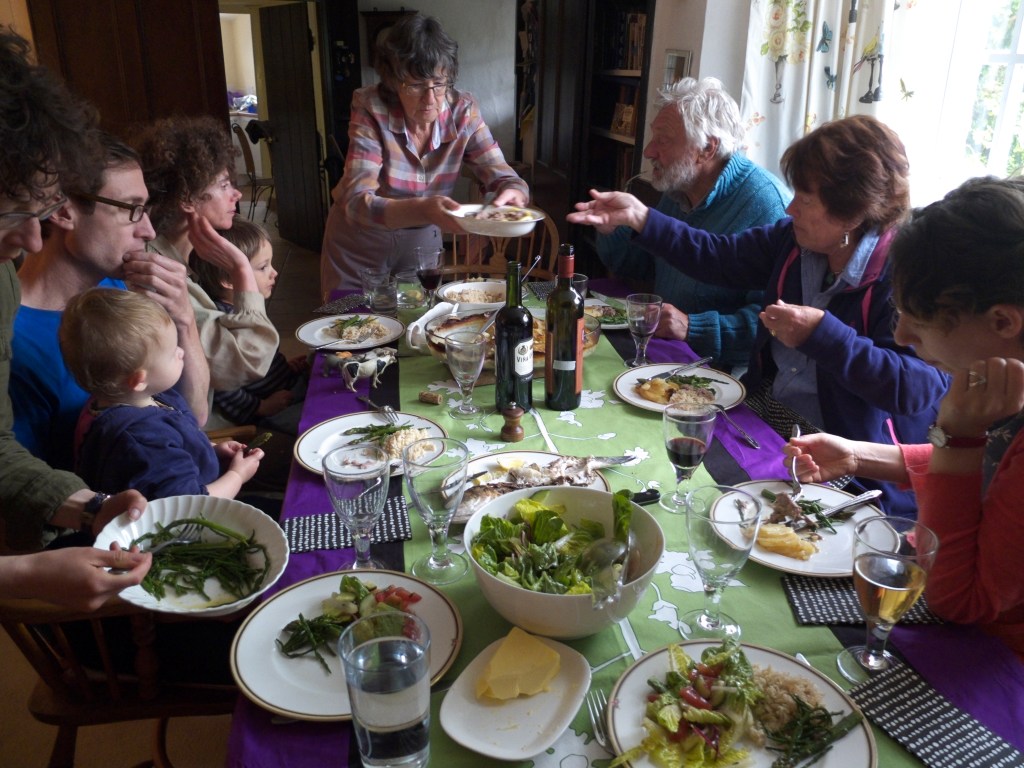
    So fast forward to 2013, here you see Malcolm, Lucas, me and our families having dinner in Loddiswell near the Le Grices’ village in Devon.

    Enthusiastic hospitality is a quality I associate with Malcolm. That’s also a quality Lucas and I hold dear, I believe. Some qualities of enthusiastic hospitality are getting really caught up in the work and wanting to share the experience of getting caught up in the work with others.  All this adds up to empowerment – participation is a political, and therefore, vital action. Making work is one way to participate but experiencing work, being part of its audience, is another. This is quite a generous way to think about work, it factors in a relationship with an audience or a viewer from the start. This evens out the power relationships in what I think are a productive way. 

    We had the good fortune to get to know Malcolm when he was thinking about legacies and how to pass them along. Of course, we have been interested in that for some time so our relationship was positive in every way. And this has been helped along greatly by Oliver, Malcolm’s son.

    And here we are having lunch with Judith and Malcolm at their home in Devon. Note the impromptu furnishing of hats for everyone and a glass of wine. 

    So that’s enthusiastic hospitality.

    The other quality I associate with Malcolm is radical sharing. In talking through how to pass Horror Film 1 on to others over 2022-24, it’s been crystal clear that the state Malcolm wants for his work is that it circulates. The words of Malcolm’s we’ve included in the Horror Film 1 instructions are these:

    “I think of [Horror Film 1] like jazz. You can have a tune and when you start to play it and improvise on it, it’s something new and it belongs to you, the performer. It’s like a skeleton around which something can happen. And I’m not precious about the copyright of it. Once you’ve performed it, it belongs in the world, right? It belongs to the world.

    And there’s also the fact that what I did was very random, really, and it was very influenced by all kinds of stuff in the situation. It wasn’t just me. William Raban, Gil Eatherly, Annabel [Nicolson], we were all working together, we were messing about doing stuff together. 

    And also the Film Co-op itself [the London Film Makers’ Co-op] … something that’s very different, particular, about the London Film Co-op – [is that] people were not precious about ideas … The ideas were thrashed around, they were shared, they were inter-influenced …it’s a different sort of culture that is in a discourse like jazz and improvisation. It can change and things don’t belong quite simply to one person. For me my work is part of a public discourse really. I’m not precious about it, if somebody wants to preserve it and work on it or be influenced by it or modify it, change it.

    I should do what I need to do [to write down instructions for the work or a letter to a future user as Louise put it] to make it possible for you but after that, it’s up to you, if you want to do something different with it … – I leave that to you, it’s not up to me.”

    So now’s the time to share your Le Grices with audiences. If you have some, organise a screening. Paddy Hay at the Artist Film Workshop in Melbourne is going to do this in late Jan, using the NFSA’s Non-Theatrical Lending Collection. Berlin Horse (1970) is not available (why is that, we wonder) but Little Dog for Roger (1967), Witchurch Down (1972)and Blind White Duration (1967) are all on Paddy’s list. 

    If you do make a screening, it would be kind to share what you do on the internet and make it findable. Be a bit of a librarian and use some hastags and include Malcolm’s name in the title. That way the Le Grice family can find what you do – I know they will be delighted to know about this activity. 

    I’m hoping to do more with a recent work of Malcolm’s, Eye of the Dragon. The soundtrack is by his grandson Benjamin. This is a three screen work but it does have a single channel iteration – I showed that single channel work in Canberra in May 2024 to a warm response from our small but enthusiastic audience.

    For me personally as a creative person, I felt quite connected to Malcolm. He was always making work – using his phone or his iPad or drawing. When we visited in 2013, he had been holidaying in Greece making iPad drawings. He’d also just made a new video work on his phone during a train trip with Mark Webber. Over this time 2022-24 when we’ve been talking regularly, he’s often showing us new images and of course, he shared Eye of the Dragon. The conjecture I put on this and that I connect to myself is that for some of us the day is not done without a new piece of art in it. Art might be the wrong word, but some sort of creative output.

    The final thing I want to say about Malcolm was that he was capable across so many fields of endeavour – he didn’t just make work, he built the early developing equipment for the London Film Maker’s Co-op, literally timber rotating tanks (my favourite account is in Mark Webber’s Shoot Shoot Shoot published by Lux for the LFMC 50th in 2016, check out Malcolm in his own words on page 104. This also explains Malcolm’s role in bringing into existence the LFMC as an organisation that did more than screenings). He also acquired the very important Debrie printer. Those who have experience in film preservation know how precious these printers are because they can cope with shrinkage and other kinds of damage. I did have a photo of the printer taken at Now.here in 2013 in London but can’t find that one. 

    And alongside his creative and engineering feats, Malcolm was also a writer. Real TIME/SPACE (1972) is still an article Lucas and I refer to often. And many bookshelves of experimental film people have a copy of his compilation Experimental Cinema in the Digital Age (2001). It was also plain to Lucas and me that Malcolm is much loved by his family, we’ve learnt this from our time spent with his son Oliver. Thank you, Malcolm, for your generous art and your generous sharing. 

  • Kambah

    A digital mapping project with the Kambah community 2020 –

    An exhibition in early 2023

    Testing participatory archiving – the case of Kambah bogan suburb

    Archivists have been working on Involving communities in selecting archives for a couple of decades, wanting to move away from being gatekeepers for collections. However, delivering on aspirations to actually build collections with communities has been elusive. There are great community archives in Australia, the Australian Queer Archives is a good example as is the ARI Remix project from Brisbane but for public collections, the goal of building and managing collections with communities is still recognised as a key challenge. 

    I am working with my community to learn what is important to them and to build a digital map of what I call atmospheres. This map forms a collection that has a potential to gather our knowledge, images and stories that the community values and to find ways to keep them for the long-term. 

    There are other innovations in this project – it uses unusual categories to prompt residents to reflect in new ways on what’s important t them, amospheres of my suburb: places to meander, places to imagine, places to go wild, for example. The digital map generates what I’ve been thinking of as a ‘performance of place’ – this is locative media for the mobile phone. Entries can be hidden, or revealed only at an approximate distances or made completely visible and browsable on a desktop as well as the mobile. While the potential of locative media for heritage collections  is well understood, the practice is still immature, I’m digging into that. You can check out the digital map although it is still in its infancy.

    A gallery visitor encounters a series of pinhole camera photographic prints, connected to the map. My suburb is famous on the internet as one of the biggest bogan suburbs in Australia. What is bogan and what does that look like? By using old media, things are slowed down, it takes time to make to take and make the image and errors show up. The pinhole transposes things, upside down and back to front, causing the viewer to look more closely to recognise the image in the first place. And that’s the point, to get people to look more closely at the very familiar, appreciating it anew. 

    Here’s the digital scrapbook https://kambahpeoplesmap.tumblr.com/

    And here’s the digital map https://cgeomap.eu/urambi/

  • Old Media Orchestra, 2020 & 2021

    This project involved inviting Canberra people to come along and help create the ‘living mural of 1970s media’. You can check that out on Instagram but you won’t see too much more than the screen shot you’re seeing above.

    IMG_6922

    Louise Curham and Richard Johnson at the Drill Hall Gallery Feb 2021 perform as Old Media Orchestra in SoundOut, the festival of new and experimental music that Richard runs each year in Canberra.

    IMG_5434
    Louise brought together the Old Media Orchestra for Art Not Apart March 2020 in Canberra at the National Film and Sound Archive. Tracey Benson made a new video work for the event. Other artists included Martyn Jolly. Support was provided by Rhys Butler, Sally Golding and Deirdre Feeney.

  • Bio and CV

    BIO

    Louise explores the creative application of old media. Her art training is in film and time-based art. She makes moving image art using hand made and hand processed 16mm and super 8 film – video art and films used live in performance. She also uses pinhole photography and cyanotypes. Making images using photography links to Louise’s second training in archives and records. For Louise, film and photography is always a form of recording. 

    Louise develops and shares much of her work in collaborations – re-enacting 1970s media art in the artist archivist collaboration Teaching and Learning Cinema and, over the years, collaborations in contemporary experimental music and dance. Recently, she has been working on creative community development in her suburb Kambah.

    Louise finalised her PhD with the Centre for Creative and Cultural Research at the University of Canberra in 2021. She went on to teach archives, records and collections in Australian universities. Before her PhD, she spent a decade working in government information and archives in the Australian Government. These engagements flow from her work in media art specialising in obsolete technology. Live arts and archives run parallel in her career. The PhD ‘Tending the archive’ draws together art and archives, exploring how we keep things we can’t digitise effectively. The research used the case study of 1970s expanded cinema, drawing on work from her collaboration with Lucas Ihlein as Teaching and Learning Cinema.

    As an archivist, Louise has worked for the Australian Government, setting policy and curating future archives. She held ongoing lecturer roles in collections, archives and records at Charles Sturt University (2020-2023) and Curtin University (2023-2025). As a consultant archivist Louise has conducted significance assessments on several landmark small arts collections. In live art, Louise performs with obsolete media such as 16mm and super 8mm film. She has collaborated with luminaries in Australian contemporary, classical and jazz music, in key venues and festivals in Australia and internationally. Louise’s films are in the collections of the region’s film archives. 

    /////

    Louise Curham Curriculum Vitae

    lcurham@csu.edu.au

    EDUCATION

    Introduction to Environmental Accounting, non-award certificate course, Fenner School, Australian National University, June 2023

    PhD Centre for Creative and Cultural Research, Faculty of Arts and Design, University of Canberra 2021

    Graduate Diploma of Science (Information Services) (Archives & Records), Edith Cowan University, 2013

    Graduate Certificate in Audio Visual Archiving, Charles Sturt University, 2006

    Master of Fine Arts, Time Based Art, College of Fine Arts, University of New South, 2005

    Managing Historical Documents certificate, School of History, University of NSW, 2002

    Diploma of Visual Arts (Painting), Victoria University, Melbourne (in part), 1999

    Bachelor of Arts, VCA School of Film & Television 1993

    Media Skills certificate, Waikato Polytech, Hamilton, New Zealand, 1990

    ACADEMIC APPOINTMENTS

    University of Wollongong, research associate on internal grant ‘Archiving Scenes, development on ASEAN Australia centre grant 2025, ARC LIEF grant 2026

    Curtin University, lecturer in the discipline Libraries, Archives, Records and Information Science, teaching archives, records, leading and managing, knowledge organisation and metadata, digital preservation, Feb 2023 to Jul 2025

    Charles Sturt University, lecturer in collections, archives, records and digital preservation, Oct 2020 to Feb 2023

    University of Canberra, Faculty of Arts and Design, course convenor, Professional Media Projects, Semester 1 2018

    University of Canberra, Faculty of Arts and Design, sessional tutor, Editing Sound and Image and Major Creative Projects, Semester 2 2018

    PROFESSIONAL APPOINTMENTS/EMPLOYMENT

    National Archives of Australia, Commonwealth Information Policy, assistant director, Canberra, 2016­–2019

    National Archives of Australia, Government Information Assurance and Policy, Digital Strategy and Solutions, assistant director, Canberra, 2014–2016

    National Archives of Australia, Government Information Management, Agency Accountability project officer, Canberra, 2009–2014

    dLux Media Arts, Sydney, consulting archivist, preparation of significance assessment under National Library Community Heritage Grant, 2014

    Performance Space, Sydney, consulting archivist, preparation of significance assessment under National Library Community Heritage Grant, 2010

    Australian National Maritime Museum, records manager, Sydney, 2007–9

    National Archives of Australia, Audiovisual Preservation project officer, Sydney, 2002–7

    Auscape, natural history photographic library project officer, Sydney, 2000–2

    Rehame, broadcast media monitor, Melbourne 1998–2000

    Short film director 1996–7

    Saatchi & Saatchi Advertising, radio and television commercials producer 1994-6

    PUBLICATIONS

    Published conference proceedings

    Curham, L., Ihlein, L., & Appuswamy, R. (2024). Re-enactment, Users Manuals and DNA Storage: Methods for media art preservation. Proceedings of the International Symposium on Electronic Art. Media Art Archiving Symposium, ISEA. https://airdrive.eventsair.com/eventsairseasiaprod/production-expertevents-public/0fa9f3be394a44dc865dc973d1d8b41c

    Curham, L. (2016). Caring for live art that eludes digital preservation. In Proceedings of the 13th International Conference on Digital Preservation (pp. 266–267). Bern, Switzerland: Swiss National Library

    Review

    Curham, L. (2017). Performing Digital Multiple Perspectives on a Living Archive. Archives and Manuscripts, 45(2), 167-169.

    Book chapter

    Curham, L & Gamble, R. (2008). ‘Moving Image’ and ‘Sound’. Keeping Archives (3rd ed.), Bettington et al (eds.) Australia: Australian Society of Archivists.

    Refereed journal article

    Ihlein, L., & Curham, L. (2015). Reaching Through To the Object: re-enacting Malcolm Le Grice’s Horror Film 1. Performance Matters, 1(1-2), 24–40.

    SELECTED CONFERENCE ACTIVITY

    The Wisdom Travels With the Object, Archives in the Digital Age symposium for the launch of the Kaldor Digital Archives, Art Gallery of NSW, Nov 2019.

    Having Opinions in Digital Preservation. Australasia Preserves digital preservation community of practice on-line meeting, May 2019.

    Tending the archive: ritual as preservation; enfolding preservation into use; and preservation as a community enabler through the case study of ‘(Wo)Man With Mirror’, a re-enactment of a 1970s artwork. Shock of the New, Australasian Institute for the Conservation of Cultural Materials joint SIG symposium, Melbourne. Feb, 2017.

    When the record performs. Australian Society of Archivists’ annual conference, Melbourne. Sep, 2017.

    Observing the re-enactment. Scenes of the Real symposium, Department of Performance Studies, University of Sydney. July, 2016.

    Tending the Archive. Australasian Association for the Digital Humanities conference, Hobart. June, 2016.

    Re-enacting Expanded Cinema ‘Wo(Man) With Mirror’, presentation at Museum Futuresconference, Institute of Education, University College London, May 2013.

    Re-Enacting Expanded Cinema: Three case studies, authors Louise Curham and Lucas Ihlein, at Re:live 09, Third International Conference on the Histories of Media Art, Science and Technology Melbourne 26-29 November 2009.

    History Made Flesh – Re-enacting Expanded Cinema, authors Louise Curham and Lucas Ihlein, poster at the Association of Moving Image Archivists Conference, USA, 2004.

    SELECTED AWARDS AND HONOURS

    2016 University of Canberra Pitch for Funds winner

    2015-17 Australian Postgraduate Award

    2015 Australia Day Award National Archives of Australia for Check-up Digital

    2013 Margaret Jennings Award, Australian Society of Archivists

    SELECTED ARCHIVES COMMUNITY ENGAGEMENTS

    Performance Space archives, Sydney, pro bono involvement 2008-2013

    Lu Rees Archives of Australian Children’s Literature foundation sub committee 2012-2014

    Art CV

    Education
    PhD, Centre for Creative & Cultural Research, Faculty of Arts & Design, University of Canberra (2021)
    Graduate Diploma Information Science (Archives & Records) Edith Cowan University 2010
    Graduate Certificate Audiovisual Archiving, Charles Sturt University, 2005
    Master of Fine Arts, College of Fine Arts, UNSW, Sydney 2004
    Bachelor Film & Television, VCA School of Film & Television, Melbourne 1993

    Solo exhibitions
    A Film of One’s Own [Archive Fever], PhotoAccess, Canberra, November 2015
    A Film of One’s Own [Fugue Solos], Performance Space 2005, NZ Film Archive Media Gallery Wellington 2006, Te Manawa ART Palmerston North, NZ 2006
    Floodgate (2006) College Gallery, QUT in the OtherFilm Festival, 2006
    Moving Still Life Blackwood Gallery Melbourne 1999, UNSW Hutchison Gallery 2002, Kudos Gallery Sydney 2004
    Herbaceous, NZ Film Archive Auckland, 2003

    Selected group exhibitions
    The Stand-in Lab with Lynn Loo, PhotoAccess Canberra 2019
    Encyclopedia of Forgotten Things, Faculty Arts & Design Group Show, Belconnen Arts Centre, May 2016
    Slowing Down Time, Belconnen Arts Centre 2015, Articulate Project Space, Sydney Mar 2014 & FCA Gallery, Wollongong Aug, 2014
    Still Life | Moving Fragments, Belconnen Arts Centre; Tin Sheds Gallery, Sydney 2012
    Propositions and Game Plans, Melbourne International Arts Festival, 2007

    Selected re-enactment events
    Teaching & Learning Cinema expanded cinema re-enactment projects inc. Horror Film 1, CCAS June 2014; Hollow in the Paper, CAST, Hobart 2013; Unconscious Archives Salon, London 2013; The Parlour in 13 Rooms, Sydney April 2013; Imprint, Artspace Sydney, 2009; Performance Space, Sydney 2007.

    As curator & convenor
    Stand-in Lab events program in the Stand-in Lab exhibition, PhotoAccess Canberra 2019
    Poetry Film screening in Poetry on the Move symposium, University of Canberra, Sep 2016
    Teaching & Learning Cinema events 2006 ongoing. Highlights include Photochemical Games and 16mm from the ‘70s the films of artist Malcolm Le Grice at Belconnen Arts Centre, Canberra 2013.

    Selected performances
    Yokohama Flowers with Erik Griswold, Brisbane 2019
    In a Bone Way with Debra Di Centa, Dance on the Edge, Belconnen Arts Centre, 2018
    Tracer film performance for prepared screen and haiku in You Are Here Festival, Canberra, April 2016 Room 40’s Open Frame with Chris Abrahams, Carriageworks Sydney, July 2015
    The Film Remains the Same film performance in You Are Here Festival, Canberra 2014
    Unconsious Archives at Café Oto, London, June 2013
    SoundOut Festival, Canberra 2013, 2014
    Melbourne International Arts Festival, Soak, with the Australian Art Orchestra, 2010
    Jazz Visions Festival, Sound Lounge, Sydney, 2010
    NZ International Film Festival, Frames Per Second A Film of One’s Own, Auckland, 2009
    Waiting to Turn into Puzzles at the Australian Centre for the Moving Image, 2008
    Val Camonica Pieces, Victorian Arts Centre, 2007
    OtherFilm annual festival, Brisbane 2006-8; NowNow annual exploratory music festival, Sydney, 2006-9

    Residencies
    Bundanon 2012; University of Wollongong artist-in-residence 2008; BankART 1929 Artists-in-studios residency Yokohama Japan 2007; Performance Space 2007; UNSW union artist-in-residence 2002

    Filmography
    Dance films: Knee Deep in Thin Air 1992; Fugue in Pursuit of Flight 1994; Slipped 1997;Doona Grrl, Transparent 2000 Other films: Johnny & Irenie 1993;The Princess & The Pea 2000; Tenho Saudades (with Peter Humble) 2004; Conimbla 2009

  • Filmography

    Dance films: Knee Deep in Thin Air 1992; Fugue in Pursuit of Flight 1994; Slipped 1997.

    Other films: The Princess & The Pea 2000; Tenho Saudades (with Peter Humble) 2004; Conimbla 2009

    Vimeo feed – lots of experimental works there.

  • Research

    Research

    Dr Louise Curham is an archivist, media artist and researcher based in Canberra. She is an online lecturer in Curtin University’s iSchool. Louise uses art and archives to explore themes that flow from old media, ranging from digitisation to the impact of algorithm-based technology on citizens.

    I finalised my PhD in the Centre for Creative & Cultural Research at the University of Canberra, Faculty of Arts & Design in 2021. You can read a blog post on my pre-submission seminar here. You can find my MFA thesis and other things on Academia. I write an occasional blog on things archives here Rambunctious Archives.

    Talks and presentations

    Curham L, Hanisch J. (2014). Towards improved metrics for information management. InForum, Records and Information Management Professionals Australasia conference, Adelaide.

    Ihlein L & Curham L. (2015). Tending the Archive. Australian Society of Archivists conference, Hobart ASA talk 2015 ‘Tending the Archive’.

    Curham, L. (2015). Tending the Archive. Talk to National Archives of Australia, Government Information Assurance and Policy branch professional update seminar.

    Ihlein L & Curham L. (2015). Panel convenors ‘Re-enactment / Repetition / Reiteration / Re-performance as embodied research’, Art Association of Australia & NZ (AAANZ) Conference, QAGOMA, Brisbane.

    Curham L. (2016). Tending the Archive. Australasian Association for the Digital Humanities conference, Hobart Digital Humanities talk 2016 ‘Tending the Archive’.

    Curham L. (2016). ‘Re-enactment practitioners’ chat’, convenor and presenter. Westspace, Melbourne.

    Curham L. (2016). The Filmmaker is Present. Australian Screen Production Education and Research Association conference ASPERA 2016.

    Curham L. (2016). Observing the Re-enactment. Scenes of the Real symposium, Department of Performance Studies, University of Sydney.

    Curham L. (2016). Expressive Instructions for Re-enactment. AAANZ conference ‘The Work of Art’, Canberra.

    Curham L and Jolly M. (2016). Convenors ‘In the Footsteps of Others’ panels for AAANZ conference ‘The Work of Art’, Canberra.

    Curham L. (2017). Tending the archive: ritual as preservation; enfolding preservation into use; and preservation as a community enabler through the case study of (Wo)Man With Mirror, a re-enactment of a 1970s artwork. ‘Shock of the New’, Australasian Institute for the Conservation of Cultural Materials joint SIG symposium, Melbourne.

    Curham, L. (2017). When the Record Performs. Australian Society of Archivists’ annual conference, Melbourne.

    Curham L. (2019). Creative Knowledge Management, PriceWaterhouseCoopers Festival of Creativity, Canberra.

    Curham L. (2019). Having Opinions in Digital Preservation, Australasia Preserves talks series, online.

    Curham L. (2019). The Wisdom Travels With the Object. ‘Archives in the Digital Age’ symposium for the launch of the Kaldor Digital Archives, Art Gallery of NSW.

    Publications

    Ihlein, L & Curham, L. (2015). ‘Reaching Through To the Object: Re-Enacting Malcolm Le Grice’s Horror Film 1’. Performance Matters 1 (1-2): 24–40.

    Curham L. (2016). ‘Caring for Live Art That Eludes Digital Preservation’. In Proceedings of the 13th International Conference on Digital Preservation, 266–67. Bern, Switzerland: Swiss National Library.

    Curham, L. (2017). ‘Performing Digital Multiple Perspectives on a Living Archive’. Archives and Manuscripts, 45(2), 167–169.

    Non-traditional research outputs

    Curham, L. (2015). dLux Media Arts Significance Assessment Report. Sydney: dLux Media Arts.

    Curham L. (2015). A film of one’s own [archive fever] solo exhibition. Canberra: PhotoAccess.

    Bullock O, Curham L, Florance C. (2016). Tracer. Performance for haiku, prepared screens and super 8 film. Canberra: You Are Here Festival.

    Cairncross B & Curham L. (2017). ‘The Parliament of Owls’, Underbelly Arts Festival, Sydney.

    Curham, L & Di Centa, D. (2018). In a Bone Way performance, Dance on the Edge season, Belconnen Arts Centre, Canberra.

    Curham L & Loo L. (2019). The Stand-in Lab exhibition. Canberra: PhotoAccess.

    Curham L & Griswold E. (2019) Dots and Loops Festival of New Music, Brisbane.

    Curham L & Cairncross B. (2019). In ‘Extra! Extra!’ organised by Lucas Ihlein, in the 50 Years of Kaldor Public Art Projects exhibition, Art Gallery of NSW.

  • Pararaha

    Pararaha

    Curham, L (film artist). (2010). Pararaha [motion picture film] Australia: commissioned for ‘Soak’ in the Melbourne International Arts Festival, Spence, A (composer),  Australian Art Orchestra (performers).

    Premier MIAF, 2010, Melbourne Recital Centre, 9 October.

    2013: Lines of Flight, Dunedin Public Art Gallery, Johnson H (piano), 21 March.

    2013: BBC Jazz on 3, Blunt, A (violin), Corringham, V (voice).

  • Two Screen film

    Two Screen film


    Two Screen 27

    Curham, L. (2005). Two Screen Film. [Moving image performance]. Sydney: NowNow.

    Additional performances:

    2005 Sydney: Realtime 10th Birthday

    2006 Sydney: NowNow with Splinter Orchestra

    2007 Sydney: NowNow with Natasha Anderson and Amanda Stewart

    2006 Wellington, NZ: Wellington International Jazz Festival with Mike Cooper

    2006 Wellington: NZ Film Archive with Jeff Henderson

    2007 Yokohama: BankArt 1929

    What is Music with Loop Orchestra, 2007

    Darlington School with Loop Orchestra, 2007

    2008 Festival of Live Art, Performance Space with Keg De Souza

    2008 Otherfilm Festival

    2009 NowNow with Anthony Pateras, Dave Brown and Sean Baxter

    2009 Clocked Out at the NFSA

    2009 Frames per Second in the NZ International Film Festival, St Paul’s Gallery, Auckland with Jeff Henderson

    2009 Otherfilm Festival with Erik Griswold

    Fit launch with Al Spence

    2010 Jazz Visions with Alister Spence Trio

    2012 SoundOut with Jeff Henderson and Hermione Johnson

    2013 SoundOut with Viv Corringham

    2013 Unconscious Archives, Café Oto London with Alison Blunt


  • Smack Bang

    Festival at Red Rattler, Marrickville c. 2010, performance with Alister Spence. This festival featured a fantastic talk by David Stratton.

    2010 Smack Bang 00